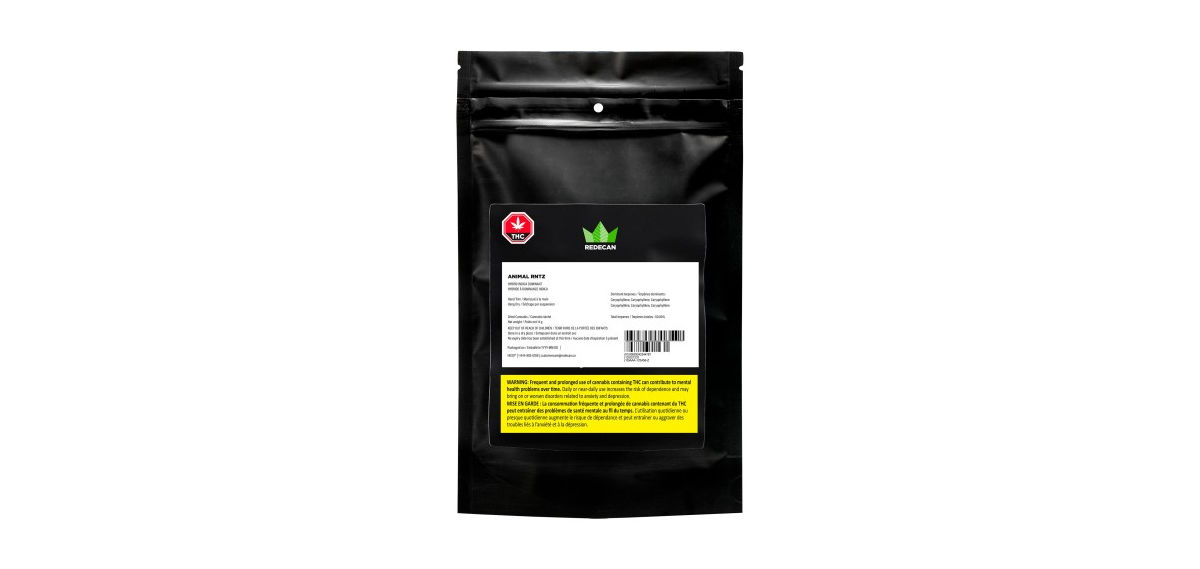
If you’ve ever investigated the packaging on a cannabis product, you know the sheer amount of product information, warnings, and compounds can be overwhelming. Even experienced cannabis consumers can struggle to interpret what the label is telling them.
In this article, we’re breaking down the standard cannabis packaging that’s required by federal law. With a little explanation, you won’t need a chemistry degree to figure out what’s going on with these labels.
Even if this is your first time buying cannabis, understanding these labels will help you choose products with confidence.
Common Cannabis Acronyms (THC, CBD) Explained on Product Labels
Federally mandated cannabis packaging takes a few liberties with common cannabis acronyms, assuming that consumers will know what they mean. But that often isn’t the case for those new to the world of cannabis.
THC (Tetrahydrocannabinol)
One acronym you’ll likely see is THC, short for Delta-9-tetrahydrocannabinol. THC is what’s known as a cannabinoid. This particular cannabinoid is by far the most commonly occurring in cannabis products, and is responsible for that feeling of being “high” after you consume the product.
CBD (Cannabidiol)
Cannabidiol (CBD) is another frequently used cannabinoid. CBD is different from THC in that it doesn’t produce any feelings of intoxication or impairment. Instead, CBD is usually used for pain management, anxiety, and bodily relaxation. Some even give it to their pets!
What Information Appears on a Canadian Cannabis Product Label
When you purchase a cannabis product, know that the packaging comes in many forms. Some products will come in sealed, squared-off bags. Others will come in little tubes. You may also see canisters with lids, small boxes, and dropper bottles.
What they all have in common is tamper-proof and child-resistant design, restrictions on kid-friendly colours, and required product label information.
Below is a breakdown of the most common elements you’ll find on federally regulated cannabis packaging in Canada.
1. Standardized THC Symbol
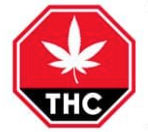
If a cannabis product has more than 10 micrograms per gram of THC, it is required to have the red, octagonal THC label on it. It kind of looks like a stop sign, and is meant to warn people that the contents in fact contain psychoactive compounds.
2. Brand Name and Product Information
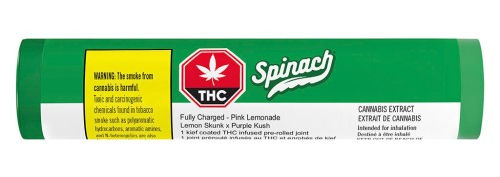
You’ll also notice the brand name and brand logo of the product. For obvious reasons, this information will look different from package to package, depending on the brand. On a square or rectangular product like a bag, the brand name is often front and centre while the logo is off to the side.
3. Cannabis Excise Stamp (Canada)
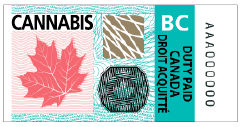
Pretty much all cannabis products will have an excise stamp on them, which indicates the product came from a Health Canada license holder. Each province has their own colour, so you may notice BC’s teal-coloured tone. Note that medically prescribed cannabis products or certain low-THC products don’t require these stamps.
4. Cannabinoid Amounts
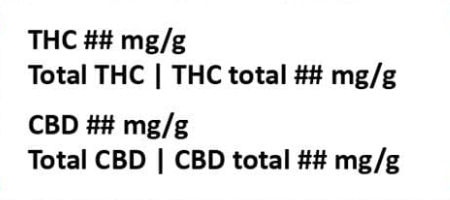
Now we’re getting to the trickier part of the packaging. In a big rectangular box, you’ll find the quantities of THC and/or CBD in the product. On some products, there will be a couple different readings to be aware of:
- The first amounts you see indicate the levels of THC and CBD in the product as purchased – that means before the product is activated (heated and consumed).
- The next amounts you see indicate the levels of THC and CBD after the product is used as intended (i.e. smoked).
Dried cannabis flower will always have two cannabinoid amount readings, because the content varies as purchased vs. when smoked. Some products have cannabinoid levels that do not change, like edibles. Here, there will just be one reading for THC and CBD amounts because they do not change.
Depending on the product, there are a few ways this THC and CBD content information will be communicated:
- By weight. Commonly seen when buying cannabis flower, this method details the amount of THC per gram of weight. For example, “THC 100mg/g”. If the total package weighs 30g, that means there’s a total of 3,000mg of THC in the whole package.
- By unit. This method is often used for edibles. Instead of measuring levels by weight, it’s by unit instead (like a candy, chocolate square, or gummy). For example, the package may say “THC per unit 2mg”. If the package contains 6 units, that means there is 12mg of THC in the whole package.
- Total amount. This method is a little more straightforward because it isn’t measured by weight or unit. It simply states the total amount in the product. For example, “THC 15mg”.
- By activation. This method is used for products that are a little trickier to portion or weight, like sprays. Instead, THC and CBD levels are measured by “activation”. In the case of a spray product, one spray would be one activation. For example, “Total THC per activation 10mg”.
5. Cannabis Health Warnings: What You Need to Know
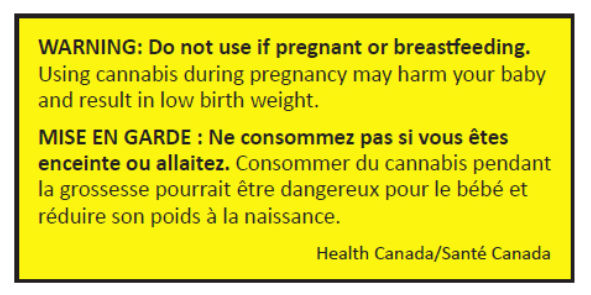
In a big rectangular box that’s highlighted by a bright yellow background, you’ll find the mandated health warning. Similar to a package of cigarettes, these warning messages are rotated around across products, with each describing a different health effect. While the message may vary, the formatting should remain the same.
6. Required Cannabis Label Information in Canada
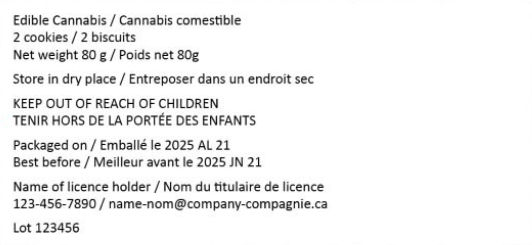
In another large box, the product must list a bunch of required information, which typically means over half a dozen pieces of info are crammed into the box.
The first piece of info at the top is the class of cannabis product. This could be dried cannabis, edible cannabis, cannabis extracts, or something else. Next is the weight.
Below weight is the dried cannabis equivalent. This info is helpful for determining whether you’re within the public possession limit of 30g of dried cannabis (or an equivalent). For example, the message may read something like “Contains the equivalent of 5g of dried cannabis”.
Below the dried cannabis equivalent info, you’ll find recommended storage conditions. Temperature, light and humidity all have the ability to modify the quality of the product, so it’s a good idea to mind these conditions.
Underneath, there will be some less useful info like a general warning for children, a lot number and packaging date, manufacturer contact info. Near the bottom, there will also be some information on intended use. Hopefully you’re aware of the intended use already, but if not, this part of the label will instruct you to inhale, ingest, or apply on your skin.
7. Ingredients List for Cannabis Products
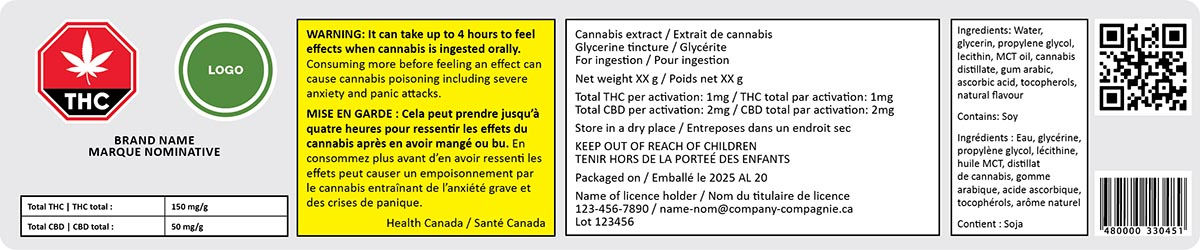
If you’re buying dried cannabis, there will be no ingredients list as nothing is added to cannabis. But if you’re buying edibles, extracts or topicals, there will be. Just like the ingredients list on a food product, the ingredients are listed in order of descending weight.
Just like food, cannabis extracts and edibles must alert consumers about food allergens. In similar fashion, edibles must also list the presence of gluten and sulphites.
8. Nutrition Facts for Edible Cannabis Products
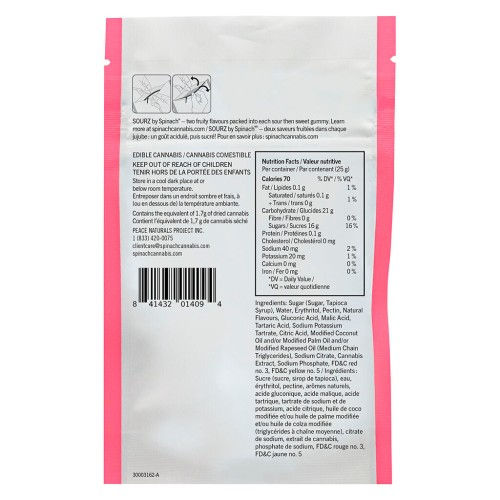
When buying edible cannabis products, you’ll notice a section of nutrition facts. Again, the nutrition facts will appear similar to a food package, because the government considers edible cannabis a food product. This section will include all the usual suspects, including calories, protein and sugar.
9. Optional Information on Cannabis Packaging
Depending on the product, you may also notice an extra section of text detailing optional information from the manufacturer. This product-specific info may give directions on how to use the product, the cannabis strain name, expiration date, or something else.
Shop all of your favourite cannabis products at Cheeky’s Cannabis online or at our locations in Vancouver, Mission, Maple Ridge and North Saanich (Vancouver Island). Skip the stress of decoding the package label by talking with our friendly staff – we’d be glad to help you find something that suits your needs.